Thursday, 27 February 2014

On Character Creation in 2.0


'With the new version comes a new way of generating characters. On paper, it is vastly different to the first iteration of the game, but in actuality the process is very similar.

In the original, a character recieved the following; six ability scores, racial bonuses, defence bonuses, hit points, and the typical plethora of armour and weapon proficiencies, skill points, spell growth, attack growth and healing surge count.
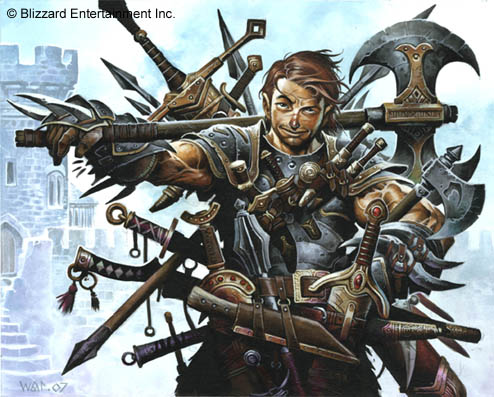
Providence Classes were built on the concept of three abilities to define a class and its play style. Paladin had Divine Aura to detect alignments, Divine Challenge to control and tank targets, and Domain of the Order for their class- orientated growth. Here, the aura and the challenge can identify and isolate enemies, while your domain choice and the traits within that choice will alter the way that character is played. As an example, this Paladin is a smiting heathen guy, so he choses the War domain, from the War Domain, he chooses access to a permanent melee damage bonus, the ability to fly into a divine rage, and improved AC. On top of all that, he also gets a 1st level feat, gear selection and so on and so on. Let us call this knightly paragon Sir Roderick of Ormley Fields, hunter of the wicked and defender of the weak!


In the new version the three abilities per character is still in effect, and is the main method of creating your character.
To recreate this character in the new edition, we select the three abilities suited to the class we want to make. Firstly, Divine Soul is functionally identical to Divine Aura, so choosing it gives Sir Roderick his ability to hunt out alignments. Divine Challenge has been replaced by Challenge; both abilities are marking tools, the new ability lets Roderick make free move actions instead of auto-damage. This makes him sticky, tanky, and surprisingly mobile. Lastly, we choose Divine Magic to allow Roderick access to a handful of Divine Spells.

So far, Roderick handles almost the same between the editions, the only major change is the mechanics of his marking tool. However, here is where the divergences begin to appear.

Hit points are not determined by class, but by which abilities where chosen. To calculate Roderick's 1st level hit points, we add the bonuses provided by the abilities to his CON score.
Roderick is a healthy man, boasting a CON of 16. Roderick generates 6 Hit Points per level (2 from Divine Soul, 3 from Challenge and 1 from Divine Magic), and so his starting Hit Points become 22.
When Roderick levels up his Hit Points will rise by 6, and his CON modifier will be added to that. Since his CON score of 16 gives us an ability score modifier of +3, his Hit Points rise by 9 for a total of 31.

Defences and skills are similar in that each ability comes with stock bonuses. Both Divine Magic and Divine Soul grant Roderick a +2 bonus to Will and Challenge offers a +1 bonus to Fortitude. However, these bonuses will never rise or change. The only way for defences to rise is through ability score adjustment.
Each ability comes with a +2 bonus as standard. Challenge offers a Nobility bonus, Divine Magic grants Spellcraft, and Divine Soul allows the choice of any skill. On top of these bonuses, we may choose from another selection of skill bonuses limited by our ability choices. Not having abilities befitting of a skill monkey, we choose Religion and Endurance for Roderick to play to his religious and knightly strengths. Other abilities would have granted him a greater selection of skills. Sneak Attack grants a Stealth bonus and an additional three bonuses from its list. However, the obvious trade off is fewer hit points per level and a list of skills that may not fit into Roderick's play style. What use is a sneak attack if he needs to be in the open, challenging things to mortal combat?
With this in mind, these particular abilities could make a funny, dishonourable knight, the kind that jumps out from the bushes and stabs a man in the back, and only then shouts "I challenge you!" Combined with some of the stealthier and sneaker Divine Spells, you can really abuse the bonus movement from Challenge to stick to the poor, poor victim.


Replacing Feats and class based growth are Talents. Each Ability comes with its own list of Talents to choose from, which in turn is supplemented with a General Talents list that offers options anybody can take. A character chooses three talents at 1st level, and they gain another one at every level thereafter.
However certain options are no longer available - in this case the Divine Rage ability doesn't exist.  If one were to make a holy warrior with a violent streak, Divine Magic could be replaced with Berserk Rage to capitalise on melee attacks and the inherent speed granted by Challenge, but Sir Roderick is not that man. Sir Roderick is a man of Divine purpose! Great, unmitigated justice! Say it again - JUSTICE~! Roderick's strengths are his speed and smiting power in a well armoured package, backed by his spells.
The first Talent Roderick chooses is Tactical Break; by ending the effect of his Challenge, Roderick can make a move action for free. This means he can move forward into challenge range, challenge his target, end the challenge and break forward, letting him get to melee range and going in for the kill. It can also be used defensively if he needs to get away. Say Roderick's Wizard friend is under threat. By shifting back and using Tactical Break, he can gain ground on the attackers and rescue his erstwhile companion.
Secondly, Roderick chooses Attacking Aura. This grants a +1 bonus to all attack and damage rolls for Roderick, and anyone in his Aura. By taking it again for his third talent, this +2 offence bubble provides Roderick and his allies a forward base, as it were, to benefit from his attack bonuses and capitalise on the protection he grants them.


So, between the editions, what's new?
Roderick is less aggressive and more supportive, although the aura and abilities could be built with killing in mind and provide even more damage instead. With the change to Challenge, Roderick can move significantly faster, and in theory, provide more coverage for the party. The number of spells he possesses have not changed, nor have the majority of their effects. However, character growth has slowed significantly.
Any defence, attack or skill increases are all talent based, it's up to the player to decide where their characters should grow. So between the two versions, the characters are pretty much equal at 1st level, minus one feat and a some increased skills. However, the difference between levels is more jarring. Character growth is a slow, natural evolution rather than a set of sudden power jumps.
In the endgame, 2nd ed characters will be weaker than their 1st edition counterparts, but their growth is more varied. Magic items and customisation selection are more important, and Sir Roderick as a character will, or at least should, grow into the man the player wants.

What do you think of fully customisable characters? We're still very much in a beta phase, but more abilities and talents are being continuously added! I see exciting times!

Friday, 21 February 2014

Pains and Painting

I am a terrible 40k collector. I have something of hobby ADHD; I build an army list, get the models, assemble and base the models, and then do nothing with said models for months at a time. I'm also a bit of a codex whore, I'm the sad act who owns every major digital rulebook release, save for the dataslates.
Recently, I've taken an interest in the Orks (thanks to the hilarious ravings of the Ork Mekboy from Retribution, mentioned in the previous post), so I dusted off the remnants of my Black Reach box set, long forgotten in the tides of modelling yore, and started gluing stuff together.
This Warboss isn't quite finished, he needs a few more layers to him, some brighter skin, another wash, and a good, thick swampy basing, maybe some mushrooms here or there!
What I find important about this little deviance is not the army, but the painting. My beloved girlfriend said to me "can I paint one?" So I dug out an old, unpainted metal Chaos Chosen and let her go mental. I taught her the basics of brush care and which brushes to use when, the importance of washes and thinning pains, and this is what came out! Meet George, Chaos Chosen:
What humbles me is that I had never expected my other half to take an interest in my hobby. I had never even considered the possibility of painting with her, and I had been ignorant enough not to ask. When George was finished, she smiled, and laughed, and said "oh he is just the coolest guy!" Or something to that effect. The important bit is her enthusiasm reminded me of what it's like to see your army roaring into combat, with every model painted and based to the best of your ability. The old adage that painted models play better than unpainted ones rings true if you really put your heart into it. It doesn't have to be perfect quality, and it doesn't have to be a studio level job, but if you feel like it was your best work, you're obviously going to be proud. You can feel that your unit is going to accomplish a great feat in the course of the game, and you feel their loss more keenly when they're off the board. 
I cringed as a volley of Necron warrior fire shot down one of my anti-tank  Stormtalons, but I whooped and cheered as the remaining two swung forward and peppered the monolith to death. Tactical Squads have drop-prodded in, bearing flamers and heavy bolters, who had to defend an objective against Deathwing terminators. Did they die? Yes, and horribly. They were completely out of their depth, and they didn't have the weapons for the job. But they held the line, the second combat squad counter-charge and survived combat long enough for the Chaplain and his own terminators to do something about them. They even brought two of the bastards down themselves, and the Chaplain's Terminators wouldn't have won the combat if the tactical squad hadn't engaged. With two tactical marines left, they held the objective and hid behind the remains of the drop pod.
Now that is an epic event, a mote of action in a much bigger game. If written up, it'd make an awesome action scene in a novel, and would open up the two survivors to some character development, perhaps promotion to Sergeants of other tactical squads. I put a purity seal on each of them, and I remember that battle very clearly. Whenever these regular Bolter boys hit the field, I feel that the squad they're in is destined for great feats.

When my girlfriend jumped for joy at the birth of George, I felt a little spark of happiness in my heart because I'd ignored the call of the hobby for too long. My head was wrapped in competitive lists and model orders, paint schemes and basing effects, future release rumours and current cheese-mongering strategies. Sometimes, we just need to take a step back and say to ourselves "I'm going to paint my Orks with bright pink lipstick, because I think it's funny!"


Tuesday, 11 February 2014

RETRIBUTION

The big drive of Providence 2.0 is character customisation. If you can imagine a character, you can build them. Don't expect first level death machines, but you can easily imprint your idea into a game. The system is by no means perfect; skill growth is relatively static, and relies on ability score increases and specific talents, and the skill list is a bit too big for my liking. However, there are lessons to be learned everywhere.

One of my favourite games is Dawn of War: Retribution. It is a standalone expansion of Dawn of War II, and is widely considered as a magical series of strategy games.
I'm a big fan of the 40k universe and it's racist, xenophobic outlook, and how the nicest race in the setting is a proponent of forced indoctrination and planetary sterilisation.
One of the best bits of the game is the Last Stand mode; one representative from each faction is put in a pit with two other random players to beat down waves of regular enemies. There are only two arenas, and the wave layouts are set in patterns and all the enemies come in the exact same formations. Each of the eight characters have their own level based system, whereby new equipment is unlocked, although the stats remain the same.
Sounds like a grind? Yes, it is a grind, very much so, but the gameplay is immensely addictive, and I believe the glory lies in the customisation.

Each member of the roster fills a different battlefield role, and each have their own strengths and weaknesses. The Space Marine, for example, is very tanky and benefits from a large selection of armour, weapons and health regeneration items. Does this mean he can be used exclusively as a tank? Absolutely not. With the holy Bolter, he can gun down light infantry, and use his abilities more often (an ability that comes at a premium for said character). With a thunder hammer, he becomes a vehicle assassin. With the lightning claw, he chops up most infantry easily. Give him a jet pack, he is an alpha striker, able to wreck units before they reach the meat of the arena and using his increased survivability to win close fights. With a plasma gun equipped, the space marine can fly out of range, taking pot shots and generally running interference.
Aside from weapons and armour, characters can take equipment and a Leadership item, an item that changes the game immensely for said character. The Marine has health regeneration, the ability to summon a dreadnought and the power to issue an orbital bombardment. Combining these abilities with the appropriate weapons and armour can lead to amazing consequences.
The bolter's ability to refresh the space marine can lead to a lethal bombard spam, the bane of any horde force. Stacking the highest armour and Regeneration leads to an unkillable tank, who can act as the an anvil, against which the enemies are struck. Instead, the Dreadnought can kick ass and take names for the glory of the emprah! How the marine is built changes the relationship with the dreadnought. With the tanking build, his regenerative and healing items will keep his ally alive, but with the pot-shot build, the two make a scary tag team, able to fell the mightiest of foes with relative ease.

But what of weaknesses? The Space Marine is slow. Without the use of the jump pack, and thus a vital equipment slot, he has extreme difficulty reaching groups of enemies in time. Secondly, the marine's energy meter, the method through which abilities are used, has very few buffs. Only the Bolter, arguably the weakest weapon in his arsenal, improves regeneration rate, meaning that his abilities are at a premium. Although they are powerful, a space marine player must choose abilities carefully lest they find themselves overrun.

This is one example, and I haven't even scratched the surface of it. I could rant for ages on the uses of the Tau Commander, the Farseer, or the game changing lag machine that is the Ork Mekboy. Each of them belong to their own role; the Commander is a ranged damage dealer without peer. The Farseer has the widest selection of support abilities in the game. The Mekboy deals damage, but his greatest strength is running interference, dicking all over clusters of enemies and tanks alike with strange contraptions, bombs, and severe teleportation abuse.
I heartily suggest picking this game up from Steam. It is a paragon of character creation where every item has uses and nothing is worthless. The animation is sleek and the voice acting is fantastic. If you design tabletop games, or want to, Retribution is a pick-me-up. Whenever I'm feeling down or frustrated, one round of the Last Stand puts me back into the mindset, and I go back to tinkering with Providence.
See you I'm the arena!

Sunday, 2 February 2014

Here in the now and the now to the Future!

 I are back! I apologise  for the lack of activity of this blog, it's been an immensely busy year and despite what I've wanted to do and write and say here. Here's a rundown:

The move went well (ish), and the new town was great.
Relationships end, relationships begin, people die and babies are born. I am now the proud uncle of two nieces and two nephews!
I was accepted to do my PhD. I work full time at mcdonalds to pay for it.
And last but not least,  Providence  has had a massive overhaul.

So, what is the future of Providence?
Well, firstly, that weekly story I promised hasn't happened at all. All of my creative time is now almost completely consumed, and the rest of my time is at a premium. I can't promise a story, but I can promise weekly updates, every Monday! I'm going to branch out from my usual game based articles, and start talking about other things close to my heart and closer to my expertise; writing, game design, computer games, and, of course, McDonalds.
I still run and test Providence, and I have those glorious boys at Alcon to thank for it's new lease on life.
At Alcon, I pitched Providence to the role playing group and it essentially got munched. Issues such as odd level scaling, imbalanced races, vaguely translated spell lists, odd resistance management, a strict class paradigm in a game based on customisation, the problems with half level scaling and skill points and so on and so forth. Basically they made me sad, but never fear! It has spawned the Providence 2.0!
Sometimes it takes the hardest hit to make the biggest change. Criticism is like dentistry. It is an unparalleled force for good, but it can hurt. The good news is 2.0 is awesome.


UPDATED RULES!
The half level growth, skill points and Hit Dice rolling are gone, and ability score increases have been added. Every character gets a +1 bonus to one of their ability scores every level. Magic item creation is simplified, magic has been standardised, and equipment selection is free form. Anyone can wear and wield anything. Items have been removed to compensate, and there is no longer a list of wondrous items. It's up to the game's designer to make any special items for their campaign, I can't shoehorn things I think should exist in someone else's world. Stats for weapons have been adjusted, and races have been balanced with comparable traits, optional ability score bonuses and a wider selection of skill bonuses. The rules for combat are largely unchanged, with only the smallest of tweaks.

CREATE A CLASS!
Instead of picking a class, you choose three abilities from a massive list, all drawn from the old class abilities. These essentially create the play style you want for your character; want a knight? Select Challenge, Equipment Optimisation and Dominate the Field for a sticky, hard to kill and hard hitting beast. Fancy a war priest? Berserk Rage, Divine Magic and Light Affinity will deliver healing and buffing and asskicking in equal measure.
Feats no longer exist, replaced by Talents. Each ability chosen for your character has a set of unlock able talents that comes with it, so you essentially create your own Talents list as well. The multitude of Feats written for the first edition have been culled and rolled together into General Talents, which can be chosen by any character. Talents are now the sole growth of everything, including skill bonuses, abilities, powers, spells known and spell slots available. You can specialise in one of your abilities, taking all of your Talents from one list, or mix and match them to cultivate the play style you want.
Hit Points and Skills are determined by the abilities you chose; abilities with more Hit Points tend to have fewer skill bonuses attached to them, whereas those with fewer Hit Points will have a greater variety of Skills and skill bonuses to choose from. The legendary CON modifier still applies to Hit Points, so careful planning can make a brutal tank or a tough little rogue.

THE ADVENT OF THE MONSTROUS!
The monsters of 1st Ed. have been rewritten. Instead of monstrous classes and racial specific bonuses, now all that there is is the racial profiles. The average monster will have one character ability to its name, save for bosses, who have three, and the rare campaign critical bosses have five (!) abilities to their mighty name. Indeed, all of the monsters have their own unique quirks, and their  profiles are just as good for PC's, if you so desire. 
I encourage you to write your own rules for your own monsters, tinker with the existing paradigms. How about an ethereal creature that manipulates reflections in a hall of mirrors, and give said ghost Sneak Attack?


The new system is being tested with a new campaign. All seems to be running smoothly, and no game breaking combination has been found, as of yet. It's a brand new dawn for this game, and I hope to share the ride with you! See you next Monday!

Tuesday, 29 May 2012

Insanity's Crown - Prologue


This is the brief introduction to a Providence game I am currently running. This is not related to the Providence Weekly story post that I promised, but it is set in the same time frame and in the same geographical location. 


Insanity’s Crown -  Prologue


            Too late and to their sorrow do those who put their trust in Gods find that trust misplaced.

Lord Garret had a good view of Remienburg. It wasn’t what other Lords wanted in a window view to work by, as a combination of trade, industry and poor planning had make the sky around the city typically grey. He watched passively from his oak chair as the refinery belched another cloud of ash, while mine carts were slowly fed into its’ gaping maw.
“Captain Mord,” he said without turning.
“Sir,” the Captain replied.
“I notice that there are fewer miners working today,” Garret said with an air of feigned ignorance.
“Sir,” the Captain replied again.
“Why is that, Captain?”
Mord scratched his chin. “Ill, Sir” he said at last.
“Indeed.” Garret stood, his thin frame barely filling the width of the window. “Determine ‘Ill’ Captain.”
Mord’s brow wrinkled, and stood in silence for a few minutes.
In Garret’s opinion, Mord had been a real find; the half-orc appeared mostly human, save for the height, muscle and fangs, and best of all, he didn’t think. Not that he was stupid; Mord knew and understood many concepts that Garret admitted he could never grasp, like how to strangle a lion in just the right place, or where to kick the door to deal the least damage to your foot. Mord did not think, he merely did. He was completely honest all of the time, because the idea of saying anything but the facts never occurred to him. He did things, and that’s why they happened, and that’s how they get done. When Lord Garret had promoted Mord to Captain of the City Watch, the criminal masterminds laughed at the simpleton Captain in the shadows. Suddenly, they found their heads lining the battlements of Remienburg.
“The workers are being poisoned, Mord,” Lord Garret said patiently, his back still turned. “The wells are clean, or we’d all be dead. The brewery is not responsible, Mr. Mallory is very careful with his ales. What do you think, Mord?”
            “Er,” Mord said, wishing for death.
            “The river Antioc, Mord” Garret said, as he slowly approached his desk. “See these reports; the farms and steads on the river have been producing less grain for years now. What else sits on the river, Mord?”
            “Skinner’s Mining Co.” Mord replied swiftly. Buildings he could do. He could relate.
            “Correct. Where are the miners of Remienburg employed?”
            “Skinner’s Mining Co.”
            “Good work Mord.”
            Light dawned on Mord’s face. “Sir, the Watch can’t investigate the mine, s’private property.”
            Garret smiled and the half-orc shifted uncomfortably in his place. The Lord’s grin was humourless, and sat on his face like a hairline crack.
            “This” Garret continued, handing the Captain a small scroll bearing his seal, “is a warrant for the investigation of Skinner’s Mining Co. Don’t press them if there are any locked doors, bits of paper missing or persons miraculously on holiday. Instead, keep a record of them, will you?”
            “Yessir. Understood sir” Mord replied.
            And there it was. He understood. This was his job, and this was all that was needed to be done, with no trimmings.
            “I expect this report by the end of the day,” Garret said, returning to his seat. “Remember, do not arrest or harass Mr Skinner.”
            “Understood sir.”
            “And fetch me Diviner Blaking, I have a few messages to deliver.”
            “Yessir. Anyone I know sir?” Mord asked, his bright-eyed grin betraying his relief.
            Lord Garret leant back into the hard wood. The sun was rising behind the smog, now. “I don’t think so,” he answered after a while. “The Inquisition, and a certain someone from Kingway Heights.
            “Hur hur, good one sir, you always make me chuckle sir.”
            So honest, Garret thought as Mord left hurriedly, it bordered on painful.

Tuesday, 6 March 2012

Updates and leaky pipes

Right, moving house is still in full swing, and as a result I haven't had the time to do as much Providence work as I wanted. As promised, the Providence Weekly will be up soon, but only until I get full blown Internet rather than huffing off of the local pub's.

Having written up the main characters of the Providence Weekly, I've also noticed a few problems with some of the existing class layouts, including typo's and class design that contradicts the mission statement;

Inquisitors gain small bonuses based on who their adventuring party consists of. This alone is fine, but the 1st level choices become extremely limiting, detailing three specific powers per selection. This defeats the point of Providence, as each style of play is tailored to one ability score, essentially forcing an Inquisitor to behave in a specific manner. This has been resolved. Each power, instead of being grouped into three, are now individual. At 1st level, an Inquisitor chooses three of these powers as his personal oath of service. Many of these powers have an INT based component to be true to their toolbox nature, and existing powers have been re-written to hammer out any confusion.One thing that alarms me is that Inquisitors gain a lot of things in comparison to other classes. Usually, I arrange class growth with one or two independent systems, such as fighter bonus feats or monk martial arts, that grant bonuses at even level. Then, every now and again, the class gains a power that defines it, such as a Sorcerer's Wings of Magic. Inquisitors have a lot of these powers, but all of them run on a large variety of skills. I worry that, since no inquisitor can make good use of the whole list of powers, some of these gifts will essentially be dead weight. Still, as far as numbers go, inquisitors are far from overpowered.

This runs nicely along to Barbarian. Aside from their 1st level choice, of which Barbarian has only a few, there is no other class customisation. Compared to more recent classes, again like Monk or Shadowdancer, this is crippling. These classes gain access to their growth system at 1st level, in Monk's case, two Martial Arts. Barbarian does not, and having run some numbers, Barbarians can't pull the same kind of weight as a Mountainheart Monk.To fight this, barbarians are being given a lot of love to put them back on their pedestal as the number one damage dealer. A Barbarian can choose 3 of their rage powers at 1st level. Since the Providence list of rage powers is a truncated and adjusted version of the pathfinder list, there aren't enough rage powers to see a barbarian into epic play and retain a feeling of individuality, thus the list of rage powers is going to be greatly increased. In addition, the list of rage powers will be rewritten to make its format more in line with the current style.

Chronarchs are a class quite close to my heart, because it is one of the few classes that I feel is original. What can I say? I'm bias.Still, after running several character sheets and listening to my friends, they felt like a one-trick pony. The whole design was built around the use of scythes, and despite a selection of 1st level choices, all of the builds ended in the same manner, were used in the same manner, and attempts to make scythes compete with military weapons was confusing.
Changes have been made.
Scythes have been dropped, so too has Cut the Weave and similar powers based on scythe play. Instead, there are Chronarch feats that grant bonuses to Scythe use to keep the original options open.
Chronarchs are now proficient with military melee weapons, keeping in line to their original basis from Battlemind/Psionic Warrior.
Army of One's effect has been changed. Now Teamwork Feats is the realm of Warlord, there is very little reason to keep the Chronarch's independent reliance on them. Army of One now grants a Warrior's Kairos at 4th level and every 4th level thereafter, which not only grants a bonus to one of the four defences, but a unique power as well. With the Warrior's Kairos, players can make any kind of time bender their minds can conceive of; a mental bastion of saving throws, an iron-hard warrior, a time thief, an unstoppable slayer, or perhaps a certain Time Lord in a blue box. I believe that is a great deal more choice than a dude with a scythe.

Clerics are getting a slight nerf, as are all of the major spellcasters. Because the spell lists of Providence are becoming so extensive, granting all of the 0 level spells as standard becomes a little bit overkill. A 1st level cleric with a high INT is, without competition, the greatest support toolbox in the game.To combat this, each of these classes will be restricted to the number of 0 level spells they gain access to, but their ability to cast them at will will remain unchanged. It is a great depreciation in power, I know, but at the same time the choices a player makes will add a certain degree of flavour to their caster.

The Rangers' Beastmaster Style will be removed from the game. This has had a myriad of balance issues since its inception, and its problems were emphasised in the fallout of Totemic. Not to say that the idea has been abandoned, it will merely be absent from Ranger. In fact, the full design for another Martial class, Beastmaster, has already been written, but the controls of the pets are still up in the air with the coming of the monster manual, which I'll get to later.

There are a few new classes in the works to fill the remaining holes in the power sources. As mentioned above, Beastmaster is a melee pet class, and is a more fiddly Martial class to counteract the more straightforward classes in the group. Runepriest is a dedicated Divine damage dealer, and will be blessed with a 1st level knowledge of Supernal and Infernal. It works by assembling letters, each possessing a very minor effect, and creating a word, which augments the Runepriest's next attack. It's still under immense construction.

Pariah is Providence's answer to Wilder. Instead of casting Psionic spells, a Pariah gains powers as they grow in level. When certain powers are used in succession, the results are impressively explosive. In addition, the nature of these powers change dependant on the Pariah's emotional state.

Puppetmaster doesn't fill a role, and chances are, it will be abandoned. Originally the pet option for Artificer, the concept if a fully customisable robot to be controlled like a second character, but since it doesn't fill a mechanical role, it will most likely be scrapped.

The Providence Monster Manual is beginning to be written. Instead of previous monster manuals, which provide one monster template for one monster level and given a rough scaling formula, I want to try something a little different. What I envision is a monster generation book that gives specific templates,allowing for pick up and play monster stats, as well as a method of creating balanced and easily scalable monsters.
Specific Monsters will be given a similar layout like the Race layouts, detailing ability score bonuses, racial powers and the like.
Monsters will grow similar to players. Monster subtypes grant a selection of powers at 2nd level and every 4th level thereafter, reflecting a monster's beastly heritage.
Taking off from where 4E started, there will be monster classes that grant bonuses at 1st level, 4th level and every 4th level thereafter. Classes such as Brute, Warrior and Leader allow for monstrous flavour, whilst allowing a clever GM to make tricky dungeon dwellers. At 5 level intervals, there are prompts for GMs to create their own optional powers for these monsters, specific twists that fits into their campaign or make a specific boss unique.
On top of all this, monster stats and classes are interchangeable with player stats and races. Why not have a human rabble of Minions, or an untrained pit fighter NPC be represented as a Brute? Equally, if you want to create a lasting necromancer archenemy for your heroes, give him some player class levels to make his level of power more apparent.

Are you excited for the coming year? I am.

Monday, 6 February 2012

How To: Class making


With the 3rd party folder open and accepting on the Dropbox, it leaves room for imaginative people to create their own classes. The following is a handy how-to for those who want to take a crack at doing it themselves, the lessons and ideas here can be transferred to other tabletop games, in addition to Providence.


The Concept
            The idea that sprang about your mind, the really cool thing you saw at the cinema, or something you’ve wanted to be since childhood. The concept of your class needs to be clear enough so people can get an immediate feel of what it does. A Fighter, for example, fights. Be sure to avoid stepping on the toes of other classes. As such, do not copy powers or class features, and if they perform the same role as another class, demonstrate how it performs the role in a different manner.


The Role
            Each class must fulfil a specific role to define its play style, and is usually decided by the Concept. Still, be sure to allocate a specific purpose for the class. Don’t be afraid to play around with the roles, and feel free to think of a combination of roles that might not be present in existing classes. Fighters, for example, are Tanks that can be tooled to become Damage Dealers by using Dominate the Field to gain bonus attacks. Paladins are also Tanks, but can be made into righteous slayers or armoured priests.

            Tanks soak damage, and generally have high hit points and a method of increasing their defences. The penalty for this is usually damage dealing potential or their skills. Tanks require a power or class ability, nicknamed the Tanking Engine, which inflicts the Marked condition on enemies, and punishes those enemies for deviating from them. Be sure to consider the potential pros and cons of your engine; Fighters can easily Mark many enemies in their vicinity, but without appropriate feats, they can only react to a few of them, and cannot react at all at a distance. Paladins can Mark anything they can see, and potentially inflict large amounts of damage even at range, but they can only Mark one enemy,

            Damage Dealers, or DDs/DPS, inflict large amounts of damage to enemies. They tend to be very dedicated in their role, and often do not deviate from the path of attack and damage. Grant powers and class features that single out targets, or offer bonuses to attacks in specific conditions or provide crippling disadvantages.
The fallout of this tends to be a weakness that can be exploited by a savvy GM. Barbarians, for example, are designed to deal the most damage in Providence. Their weaknesses are a fairly low AC, and their Rage power prevents all kind of clever thinking. Although this is offset somewhat by a massive pool of Hit Points, a GM can lead a Barbarian player into a mid-combat trap, or trick him into charging allies.
Rogue is another example, although it straddles the Damage Dealer and Toolbox roles. Rogues have very limited damage potential, as they do not have access to a great number of large weapons. However, their Sneak Attack class feature does spectacular damage to compensate. There is a drawback, however, as Rogues can only inflict this damage against opponents who grant Combat Advantage, thus limiting their effectiveness.

Toolbox characters perform acts that other characters generally can’t. This often includes a large skill list and a large pool of skill points, as well as other powers that twist the natural workings of the game. Toolboxes are often combined with other roles to a greater or lesser extent, so be sure to include a method through which their utility powers effect the outcome of a battle. Many Toolboxes are more frail in combat than other classes, and have very few methods of making themselves tougher.
Rogues are a skill based Toolbox, potentially having the most skill points available to a single class. Combined with their Rogue Talents class feature, they can trick, convince or mislead enemies into odd positions, and capitalise on their weakness with their Sneak Attack feature.
Totemics have the power to transform into animals. Their unique forms are their greatest strength, for who better to infiltrate the castle than a rat, or to search for sunken treasure than a shark? Totemics are not frail in direct combat either, but can be at a loss if they do not possess an appropriate form for a task.

Support characters are used best with allies, and are generally very weak on their own. In exchange for other essential scores, Support characters grant impressive bonuses to their allies, and sometimes ail their enemies. Think of a system through which the class can grant bonuses, and consider putting a limit on the usage of such powers if they are powerful enough.
Bards are the king of Support classes. Although they are part-way Healer and Toolbox as well, their song can grant fantastic improvements to their allies’ fighting power, potentially making an impossible encounter conquerable. However, Bards are also frail, and must stay close to danger in order to grant their bonuses.
Faustians do not aid their allies at all, instead choosing to cripple their enemies with powerful curses and irresistible hexes, while their Familiar transforms into a mighty beast that can fill any potential role in the party. Still, Faustians have no real fighting power on their own, low health and low defences. Coupled with their sacrificial Manifestations, they are easily singled out and destroyed.

Healers have the power to aid failing allies, often restoring Hit Points, granting Temporary Hit Points and allowing Saving Throws. All Healing classes have a Healing power, nickname the Main Heal. Main Heal powers are all minor actions with a Range of 5, restore one Healing Surge, can be used at least once per encounter to a maximum of three times, and has an additional effect. Be sure to differentiate yours from the rest with different effects. Healing Word, for example, restores an additional 1d6 Hit Points that scale with level, whereas a Bard’s Majestic Word restores an additional number of Points equal to their CHR modifier.
The style of healing is also a factor for the creation of healing classes. Clerics and other Divine classes must be adjacent to allies in order to heal them, whereas Druids can heal with ranged Primal spells, but the healing is slow, and takes time.


The Power Source
            This is where your class gains its power from and is the source for much of its flavour. Try to adhere to the conventions of the Power Sources, as they are designed to be easily identifiable categories through which later class choices are made.

            Arcane classes are magical by nature. All of the classes in this source have access to the Arcane Spell List or accrues Magic Points. This list is long and very in depth, so be aware of the maximum spell level and the number of Magic Points you allow your class to have access to. Sometimes, although not always, Arcane classes can change the way their spells work, or put them into effect where other classes cannot. Arcane classes have no dedicated melee class at their disposal, and to the same degree, they have no ability to Tank.

            Divine classes worship Gods. They also tend to be very flexible, although Divine classes have trouble fighting at a distance. In addition, each Divine class has the Divine Aura class feature, through which you can choose to manipulate the class features. In addition, you can give your class access to the Domains list as a means of customisation. Alignment is important, and based on the deity players worship, so feel free to play around with alignment based bonuses.

            Martial classes are based on physical prowess over supernatural power. There is nothing mystic about the Martial classes, as they have no power that is conceivably impossible to mortal man. Keep this in mind as you think of your character’s abilities. If inspiration evades you, look to the modern world of guidance, as truth is often weirder than fiction. Consider item based powers, such as granting attack rerolls or the ability to wield mundane items as lethal weapons.

            Primal classes revolve around the natural world. Think like a hippie; try to stay away from man-made weapons and armour, and design creative ways of circumnavigating these problems. Primal classes tend to be very extreme in their inherent build, so try to stick to a maximum of two Roles when creating your character, if not one.

            Psionic classes use the mind to wield the soul as a weapon. They follow the theme of spending resources, so it is recommended that you have a resource-based ability list to draw on. Although Power Points is the resource engine of Psion, feel free to use it if your Psionic class uses Psionic spells, as Power Points are specifically used to empower such spells.

            Shadow classes are more sinister than other classes. Theirs is the theme of the pact. Of the existing classes, this takes the form of a physical reminder, with Faustian epitomizing this source with their Familiar. Do not feel constricted by this idea, the pact can take one of many forms. Shadow classes also tend to be very flexible, and have unique powers. Healers do not fit into the realms of the Shadow class.


The Alignment
            Set which of the nine alignments your class must adhere to. Personally, I dislike the concept of alignment restriction, and as a result all of my classes can be any alignment. Still, be sure to note that certain classes tend to swing in one direction more than another. It is conceivable for a Barbarian to attempt to be a law-abiding citizen in a large town, or a Paladin to belong to a Chaotic Evil God.


Key Abilities
            Set the key ability scores for your class. Make them MAD! By that, I mean Multiple Attribute Dependant (or Disorder, as I like to think). Make sure your class has four or more attributes to revolve around. Make sure class features and powers fit with the right attribute. The reason for this is to make a player think about their class choices. If there were only two ability scores that effected the class, then all of the characters would handle the same. By expanding your classes’ horizons, you have the chance for players to create the same class, twice, in a completely different manner.
            Paladins are the perfect example of MAD; a Paladin needs STR to land hits, but might need DEX to increase their AC. If they want to Tank, they will need a semi-decent CON score, but at the same time they need a high WIS score to fuel their Divine spells. On top of all that, many of their offensive powers run on CHR. In fact, the only ability score that isn’t used at all is INT. Then again, if the Paladin wants to be of more use to the party or perform more unorthodox combat manoeuvres, they just might need that INT score.
            Here, there are multiple uses for Paladin, all of which are perfectly viable, but run off differing combinations of scores, such as the shield warrior (STR + CON), the frontline healer (STR + WIS), the righteous slayer (STR + CHR), the armoured priest (WIS + CHR), the nimble powerhouse (STR + DEX) and so on.

            Strength (STR) is the basis of all melee attacks. The easiest way to include it is through melee classes, although it is possible to create a lethal ranged class that gains a STR bonus to spells and or powers. When writing powers, emphasise damage, size and killing things in general.

            Dexterity (DEX) governs a lot of things, and is arguably used more than any other ability score. Make this a priority if your class makes extensive use of ranged weaponry, light armour or is designed to dual-wield. It also governs a great deal of skills. Be in mind that the Weapon Finesse feat can alter a ranged class into a melee class by using DEX instead of STR for melee attacks. If you want your class to stay at range, give them powers that work best at range. When writing powers, focus in on movement, delicate aiming attacks or tricky manoeuvres.

            Constitution (CON) is often overlooked, because it is difficult to envision as a tool to be used. A friend once said to me it can be considered how fat you are. If your class tanks, it is wise to prioritise CON. When writing powers, think about powers that grant bonus Hit Points, saving throws or damage reduction. CON is the score used to determine the attack and damage rolls of Psionic spells.

            Intelligence (INT) is the basis for skill growth. It also governs a lot of skills, so remember to consider how many skill points to attribute per level based on the need for INT. When writing powers, reward clever skill checks, traps, and thinking outside of the box. INT is the score used to determine the attack and damage rolls of Arcane spells.

            Wisdom (WIS) handles the dissemination of information. Many classes can make use of WIS, as it is essentially common sense. When writing powers, remember that sensible actions are often the focus for WIS, and should be rewarded as such. WIS is the score used to determine the attack and damage rolls of Divine spells.

            Charisma (CHR) is essential for NPC interaction. Witty characters or those with a strongness of heart should benefit from a CHR score. Feel free to write powers with more eclectic effects. CHR is the score used to determine the attack and damage rolls of Primal spells.


Proficiencies
            Choose which tools your class will wage war with. Remember that each piece of armour and each weapon have its own advantages and disadvantages, and must consider this when choosing your classes’ role. Heavier armours are generally used by more melee orientated classes, whereas the lighter armours are favoured by Toolboxes, as to avoid skill penalties. Feel free to restrict your character to one specific item or set of items rather than a whole category.
            As standard, only Paladin can wear Super-Heavy armour at 1st level without the aid of feats. In addition, it is rare indeed that a class has access to the whole plethora of Martial weapons, and rarer still have proficiency with a Superior weapon as standard.


Bonuses to Defence
            A slight increase to your classes’ defences is needed, mainly to add 1st level flavour, and in part to set them aside from the rest. Choose either a +2 bonus to one of Fortitude, Reflex or Will, or a +1 bonus to two of them. This puts a defensive emphasis on your character, and adds some definition to the class. It only makes sense that a Rogue is good at dodging, or a Psion has a might will.
            On rare occasions, you might feel that your class has such a broad spectrum, than neither option really fits. In such circumstances, grant your class a +1 bonus to all three of these defences to reflect this. This is not a common tool, and usually it is granted to compensate for some initial weakness in the class.


Hit Points
            The Hit Points you grant your class define much of its playing style, and indeed, defines its role numerically. At the lowest end of the spectrum, many cloth-based classes will gain d4 Hit Points per level, as befitting their frail nature. At the other end of the spectrum, d8 Hit Point growth belongs to the heavier classes, such as Tanks or frontline Damage Dealers. The d10 growth belongs almost exclusively with Barbarian, keep this in mind if you decide to grant a class such a large pool, and be ready to make a sacrifice somewhere else amongst their design.
            Of course, these definitions are based on the Providence RPG design, for D&D and Pathfinder, the dice standard is different, but the idea is the same.


Healing Surges
            Choose between six and twelve healing surges to grant your class. This is a measure of how much they can be healed, so a back line class will not need as many as a front line class. Be careful with the number of surges you grant, as too many surges means that there is no threat of ever running low on Hit Points.


Skill Points
            Decide on how many skill points you want to award your class with. Many classes do not have a great number of skill points, as it is the realm of the Toolbox. To aid your decision, think about how you want your class to perform in terms of skill;
If the class is likely to have a high INT score without being a Toolbox, set the bar low, a 2 + INT modifier. This way, their skills grow at an accelerated level without any particular effort.
If this class is a Toolbox with a high INT score or a different role that leans toward a Toolbox mindset, set the growth rate at 4 + INT modifier, allowing for rapid skill growth.
If the class is a Toolbox, but with only an optional use of the INT score, use 6 + INT modifier for skill growth. This way, skills will grow at an accelerated rate without the player input. If the player does decide to give attention to INT, then their skills will rise at an unparalleled rate, so long as this decision is at a detriment to another aspect of their class.
 If your class does not emphasise skills or INT at all, then leave the skill growth at 2. This will provide enough points to add some utility and flavour, but not enough to distract it from its real role.


Skills
            Decide on a skill list for your class. The number of skills and which skills to use are heavily dependant on the ability scores you chose to focus around. Pick skills that both make sense for your classes’ image, and are aided by the ability scores chosen. A heavy, frontline fighter will often be adept and jumping and climbing, whereas a light, sneaky character will need skills to balance and pick locks. Remember, a class cannot possess the Fly skill unless they have an ability in their eventual growth that allows them to fly.


Attack Growth
            Determine how quickly your class gains new attacks per standard action. A growth of 6 is for main damage dealers and other melee-orientated classes. A growth of 7 is for Toolboxes, and other roles that have viable melee potential, but not as adept as others. A growth of 8 is for spellcasters, and other such archetypes that do not wade forward into the fray to gain much of combat experience. The attack growth of 5 is exclusive to Fighter.


Class Features and Growth
            The meat of class creation; decide what your class will do, and how it will go about doing it. This is where many of the inspirational ideas you’ve had accumulates into class growth, but there are still a few things to consider.

            Find one theme or ability, and focus around that. Turn the key ability into a platform from which you can write other powers.

            Offer a choice of ‘build’ at 1st level. A broad-ish selection of minor powers suffices, enough to grant a feeling of flavour and individuality but not enough to overpower the class. If possible, make it tie in with your classes’ primary ability, or make the choice enhance the existing power.

            Keep the 1st level bonuses as concise as you can. 1st level characters are above average persons, they are not heroes just yet, make them earn their growth by limiting what they have access to at 1st level.

            Avoid dead levels in character growth. Customisation is key, make sure that from levels 1-20 the class has something new to offer.

            Choose which kind of growth to employ. The easiest strategy is to grant set powers or abilities at every even level, and allow feats to take the odd levels. This can be a very lengthy process to write the full extent of powers and abilities, but it is often worthwhile. Another strategy is to do a paralleled growth style, namely at 2nd level and every 4th level thereafter, and at 4th level and every 4th level after. This allows for two different bonuses and themes to grow in the same class. A third, and less desirable, option is fixed growth. Write every power and ability at even level, and offer the player no choice as to how they develop. Although this is restricting, it can be very balanced, as there is little to no room for finding that golden, game-breaking combination you hadn’t considered. This style usually grants specific, awesome powers that outclasses any choice, and is often employed for spellcasting classes, who already have a great deal of customisation via their spells.

            Does your class employ magic? If so, restrict the amount of customisation your class has to a few feats or select powers, as the sheer scope of the spell lists alone far and away surpasses the options for non-spellcasters.

            Does your class have a great power that needs restricting, like a Barbarian’s Rage or a Bard’s Song? If your classes’ effects are too powerful or open to abuse, limit the number of times per day they can be used. An easy option is to tie the duration to a specific skill. Barbarians, for example, can Rage a number of rounds per day equal to their Endurance skill.

            Does your class have a resource? Think of ways your resource can be used in the most creative manner possible. How is this resource managed? How is it spent, and what happens when it is? How does your resource recover?

            How complicated is your class? Be careful of straying too far outside RPG conventions or introducing too many class-specific terms. If your class is fantastically complicated, be very careful it doesn’t become convoluted in execution at the risk of losing potential players. If others have trouble understanding it, layout is your best friend. Use smaller sentences, use subtitles and make paragraphs more obvious. Anticipate the questions asked of you.

            Reward players for taking your class to 20th level and beyond. Prepare a fantastic power that is so good, it entices players to go the distance with yours. Once per day powers are a good choice, potentially involving something like a perfect success skill check, an irresistible spell, or an instant-death attack.

And so
            I sincerely hope that you find the inspiration to write your own class, because I can promise you there’s nothing more exhilarating than seeing another person enjoying the workings of your class.
            Don’t be afraid about getting it wrong; start underpowered and work upwards to an appropriate strength level. You’ll have to test your class into destruction before you get it right. Have a calculator with you, and assume all ability scores you class works with will be at 18 at 1st level.
            Have fun, and I hope to see some works of art soon!